

Abdul Mannan Sarkar, The Bullock (History)
 Moderator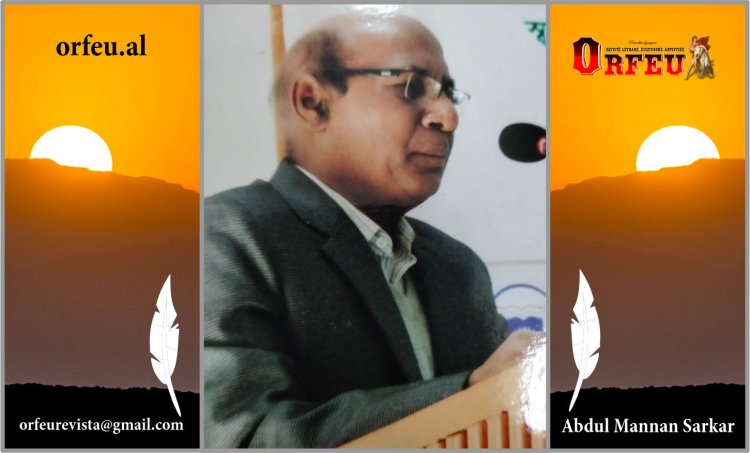
Story of Abdul Mannan Sarkar, edited by Nurul Hoque, published by Angela Kosta.
The Bullock
Story by Abdul Mannan Sarkar
Having passed the forty-year mark of his life, Rajab Ali cannot think of himself as anything but a bullock. The animal grazing with its head bowed before him shares a resemblance with him, and Rajab Ali understands that this resemblance is innate. He stares at the bullock with placid, cow-like eyes, filled with pity and an astonishing tenderness. It survives only on grass and water; the landowner placed the yoke on its shoulders long ago, and it will not come off until death. Rajab's own white, placid eyes gradually turn crimson.
"Bastard, can't you even uproot the tethering post? Have you no strength in your body?"
Rajab Ali now vents his anger on the bullock.
The bullock grazes, lost in its own world. Head bowed, two placid, indifferent eyes, large white orbs utterly devoid of thought. The leftover grass trampled under the hooves of the cows; it knows that little is its due, no more than that. It has no right to stretch forward and eat the fresh, tender grass.
The thought that he too is deprived, just like that bullock, kindles a burning ache in Rajab's chest. He takes a long drag from the hookah, exhales smoke in gurgling streams through his nose and mouth, and loses himself in the realm of smoke. The bitterness of his mind collects on his lips, and he sets the hookah down with a clatter.
He looks at the bullock again with furious eyes.
"You wretch, you only have this body!"
Rajab Ali looks at the bullock once, and the next moment at his own body; his body is sufficiently sturdy, but he takes no pride in it, thinking it is precisely because of this body that he can manage two meals and clothing. "The landowner feeds you because of this very body, you see." He says this aloud, as if for the bullock to hear. Rajab emerges from the cowshed, looks ahead for a moment, then averts his gaze. Before his eyes are the green fields of khesari and gram. The gram flowers are blue, resembling women's nose ornaments. Bees and wasps are buzzing about.
These bees collect honey drop by drop, store it in their hive, and then one day, man breaks it and takes it all away. He himself has broken hives many times. Rajab likes the bees with their golden wings. How they work! Rajab also works with his head down. He never protests against anything, doesn't know how to protest; his life, like that bullock's, is devoid of rebellion, devoid of protest. Why? The answer to this 'why' has perhaps rendered Rajab mute.
Yet, he is astonished when he thinks of his mother, 'Thoshi'. The old woman doesn't hear well, or hears very little, which is why people call her 'Thoshi'. She has lost one eye, her back has been bent for many years, she walks hunched over. Children are afraid of her because she looks ugly. Mothers scare children with tales of 'Thoshi' before putting them to sleep. Even at this age, however, the old woman shows no deficiency in her work. With her emaciated, bent body, she works tirelessly without fatigue. She manages the landowner's household single-handedly, does all the work—boiling rice, drying it. Thoshi is a woman of a stubborn nature. If Rajab Ali ever says to his mother, "What need do you have to work? Can't I provide your food and clothes?" the old woman flares up and says, "You son of a...! Would I eat from you? Have I no strength left in my body?"
It's not that the old woman works only for herself; all her worries are for her son Rajab. She always wants to keep an eye on her son. Otherwise, she finds no peace of mind. Wherever Rajab will work for a landowner, Thoshi will take work there. The old woman never thinks of her own toil, but if she feels her son is being worked a little too hard, she goes to the field. She becomes terrifyingly rebellious. If she feels her son is being worked to death, she will raise a commotion in the neighborhood, shouting and gesticulating wildly in front of the landowner. Once, she even chased the landowner with a sickle. Yet, despite being the son of such a mother, Rajab never learned to protest. The old woman has endless regret about this.
Why must my son silently endure every task, why does he never protest?
The father's fiery blood surely runs in his veins—does a trace of my own blood remain at all?
The old woman laments, striking her forehead in despair. Yet, Rajab never once found the courage to raise his voice before the master. This old woman knows her rights all too well. She will work, but only after securing every last bit of her rightful due.
During the fasting days of Ramadan, the old woman will never break her fast at the master's house.
She fears being obliged to share the merit of her fast. Instead, she runs to the river, drinks water there, and only then returns to take her meal at the master's home.
Thinking of his mother, Rajab smiles quietly to himself.
Antora’s calf is utterly beautiful. It was born just a few days ago to Antora.
Dappled in white and black, with long, languid eyes that are even more lovely—deep, tender eyes that make you want to caress it.
Being a male calf, it is restless, darting about constantly. Now it stands in the middle of the field.
Perhaps tired from all its running, it is taking a moment to rest.
Gazing at the calf, Rajab Ali heaves a long sigh. He, too, had such a childhood once.
No—nothing from those carefree, unbounded days comes back to him now. His maternal grandparents’ home, their affection… none of it lingers in memory. All he has heard is that his mother’s parents lived very far away. The few childhood memories that do surface are these: holding his father’s hand, he went fishing in the marshlands; and a handful of times, he visited fairs or marketplaces.
It was in that very childhood that his father put him to work as a cowherd in the master’s house, just to fill his belly.
His father breathed a sigh of relief—no longer would he have to scrounge for his young son’s next meal.
The calf is nursing from its mother’s udder. The cowherd Abul shouts out, “Hey, Kaka! The calf’s sucking at Antora’s teat! How come you’re not saying anything?”
“Let it drink,” comes Rajab’s unconcerned voice. When Abul tries to speak again, Rajab flares up. “Shouldn’t a calf drink its mother’s milk? Didn’t you drink from your own mother?”
Abul is left stunned by Rajab’s words. He has never heard such reasoning before, and unsure how to reply, he falls silent.
The cows graze peacefully, only occasionally disturbed by swarming mosquitoes and flies. Tethered to their stakes, they graze within their allotted circles, none trying to uproot the stake or stretch beyond for grass. If one of the younger heifers makes an attempt, cowherd Abul lashes it hard with his whip. The cows feast on the thick, lush khesari and kalai grass in the pasture with almost festive relish. The air carries a wintery chill, though true winter has not yet set in.
Antora’s calf has again stationed itself in the middle of the field. It hasn’t yet taken to grazing, but it sniffs the swaying tips of grass, trying to nibble a few blades.
Suddenly, the calf leaps up on all fours and dashes forward like an arrow.
Still unsteady at such speed, it stumbles now and then, tumbling to the ground.
Moments later, it springs up and starts sprinting again. Now it stands perfectly still—something has caught its eye.
It chases the mynahs and herons that forage in the field. Rajab draws on his hookah and laughs, rolling with amusement at its antics.
Rajab remembers—in childhood, he too used to chase dragonflies and butterflies just like that. For a moment, he is transported back to those beautiful, distant days. The calf runs back and nudges its mother’s udder—not from hunger, but simply to play-fight with her.
Rajab reflects on his own life: No, how can anyone remember things from such a tender age? His wife Amiron holds their one-year-old Rafi. How often the boy fusses, throwing off her sari, refusing to nurse, yet pounding her chest with both hands. Flustered and embarrassed, Amiron sometimes smacks the child’s mouth in shame.
Then, a fierce quarrel erupts between husband and wife. Other times, Amiron may not want to nurse, but she will press the boy’s face firmly against her breast anyway.
Son is not less, once he gets a taste of milk, he bursts out laughing with delight."
Right now, Rajab feels even fonder of the calf. A thought dawns on him—isn’t every child in the world just the same?
The calf begins leaping about in the grass again.
Abul says irritably, "Hey, Kaka, why not tie up the calf? What do you say?"
"Why so angry over there, Abul?" Rajab replies, then addresses the calf, "Go on, leap while you can. How many days will this frolic last? Soon enough, a rope will circle your neck, and a muzzle will cover your mouth."
Being a male calf, its spirit runs wilder. Perhaps its very blood tells it that it was born a bull. A fierce, pulsating vitality keeps it intoxicated.
"Kaka, it’s ruining the grass—I’m telling you, tie it up!" Abul’s voice is thick with annoyance.
Rajab’s heart doesn’t agree with tying up such a young calf.
"What’s wrong with you, Abul? It’s only been two days since it arrived—let it learn the place, let it know its world."
Abul doesn’t care for Rajab’s cryptic talk. He says, "If Sarkar Chacha sees the grass damaged, he’ll be furious—and that anger will fall on me, not you."
Perhaps just to spite Abul, Rajab goes and brings the calf back. Restless in Rajab’s grip, the calf struggles. But instead of scolding it, Rajab strokes it tenderly. He runs his hand over its head and murmurs, "How soft your skin is… so beautiful. But this softness won’t stay.
Right now you drink your mother’s milk—in a few days, even that will be denied. You’ll have to graze on grass, and soon after, a rope will go around your neck, a muzzle will be put on your mouth so you can’t reach the udder.
Do you know why?"
Rajab rubs his face against the calf’s—he smells the scent of fresh milk. The calf gazes at him with large, wondering eyes. Through animal instinct, it senses Rajab’s genuine affection. As if answering it, Rajab continues, "You’ll have to wear the muzzle, become mute, lose all claim to milk. This is what you must accept, understand? You must accept it. You’ll only obey the law, yet you’ll never quite grasp who made that law in the first place. Still, you must follow the laws set by humans, the laws made by clever men.”
As he goes to put a rope around the calf’s neck, Rajab hesitates for a moment. Can such a young thing bear a rope? Could it tighten and choke it?
So he sets the rope aside and twists a cord from grass instead.
Abul holds the calf steady. Rajab loops the grass-made noose around its neck—it looks almost like an ornament.
But it isn’t an ornament; it’s a shackle.
And isn’t he himself shackled too? Is he truly free? The thought jolts Rajab.
He starts talking to the calf again.
"Yes, laws made by humans… even you must obey them.
Just because you’re helpless doesn’t mean you’re outside the law. And no one is outside it—not even me, bound as I am to the master’s house."
"What are you saying to that calf? Kaka. You hardly ever want to talk otherwise."
Abul says it with surprise.
It’s true—Rajab speaks very little. He rarely says more than necessary, often settling matters with nods and grunts.
Many are annoyed by Rajab’s silence. "Does it hurt your mouth to speak, Rajab?"
If someone jokes this way, Rajab only glances at them briefly, then lowers his eyes and returns to work.
Who would seek conversation with such a man? So no one does.
But sometimes, words seize Rajab—and then he speaks openly, freely…
He talks to cows and calves, to the sky, even to his own shadow.
If someone calls a man who talks to his shadow mad, can they really be blamed?
All my life I’ve trailed behind oxen—what would you call me then?"
Chacha Shaber once said this in jest, but there was bitterness in his words.
From his own life, Rajab has come to understand what Shaber Chacha meant.
You must become an ox. You must become an ox.
“One day, you too will grow up. People will turn you into an ox, they’ll make you a castrated beast, cut off your two testicles. You know why? No, how would you know? How could you ever understand the cunning of humans?
Look at you now, just a stray little calf. One day you’d grow into a bull—but that won’t be allowed. A bull is dangerous. Then you wouldn’t obey rules; you’d walk with your head held high. You couldn’t be tied down. You’d show your strength. But once they turn you into an ox, that strength will be gone.
Then you’ll keep your head lowered, eat grass, obey commands. You can’t yoke a bull, but an ox—yes, an ox can carry the yoke. Yet the real danger—you’ll never understand it. Your body will never burn with that fire, you’ll never father a calf like yourself. Humans are deeply deceitful.”
Rajab’s words seem to have no end. He lifts the calf’s face. What does he see in those large, dark, expressive eyes? The calf stares back like an innocent child, as if it, too, understands Rajab’s language. Its eyes appear moist, and Rajab, too, wipes his own tear-filled eyes with the back of his hand.
"What are you talking about so much with the calf, uncle?" Abul’s words do not reach Rojob’s ears. Like a man in a delirium, he continues to mutter. "I saw my Saber uncle; he had a strange, deep affection for the oxen. People used to mock him, but Saber uncle never got angry. Why? Wouldn't a helpless soul feel for another helpless soul? That is why I will never let them turn you into a beast of burden. Do you understand me? But how could you?"
"You are not meant to understand. The Almighty hasn't given you the power to comprehend human speech. Why hasn't He? Because you must serve as their slave. If you understood, perhaps you would refuse. Humans are terribly wicked. They just want to put a rope around everyone's neck. It is true that I don't have a visible rope around my neck like you do, but the rope is there; it's just unseen. My father and grandfather lived in servitude, my mother does, I do, and my son will too. Slipping off this noose is no easy task. I have a vote, don't I? But can I cast it myself? No, I cannot. I have to vote according to the landowner's word, the village headman's command. I must vote for their chosen symbol. I have no symbol of my own."
Rajab wishes to pour out so much more. It is as if unburdening his soul to this mute listener is his only salvation. He doesn't even remember when he first entered the landowner's house. He tended to their cattle, carried meals on his head to the farmhands in the fields, and ran endless errands for the women of the household. After a full day's toil, he would sit in the courtyard to eat his meal—often just stale, watery rice. The beautiful days of his life were spent in the grazing pastures; when the grass grew tall and the herds gathered, he stayed with the cows, sleeping huddled together in the hut. At night, after work, he listened to the reading of ancient manuscripts or the verses of wandering minstrels. The flute used to call to him then; he secretly dreamed of playing it when he grew up. He never did get to play that flute, yet the days of his childhood and youth now seem like a distant dream. He had to marry quite late in life; having no land or wealth, who would willingly give him a bride? During those turbulent days of youth, how much time did he truly get to spend with his wife? After finishing the chores at the master's house and eating, he would set off late at night, only to rush back before dawn to thresh the paddy.
"I haven't had a single day in my life to live on my own terms," Rajab sighs as he says this, looking toward the oxen. The innocent creatures are grazing with such stoic indifference. Rajab glares at them with a sudden, fierce anger. Perhaps it is his own profound helplessness that fuels this rage.
"No, I will not let you become an ox; I will never let them turn you into a beast of burden."
As his child's smiling face floats before his eyes, Rajab wants to scream with all his might.
His jaw clenches, yet his two clenched fists tremble violently. Can he shape his son’s fate differently? His son, too, will be merely a body of flesh and blood—a physical being whose only asset is its body. Exactly what he inherited from his father. Rajab shakes his head vehemently: No, I won’t let them turn you into a bullock. This seems to be Rajab’s first act of rebellion. And the calf, subjected to this smothering affection, lets out long, drawn-out cries again and again.
A few months later, the calf has grown quite sturdy. For a long time, the landowner, Afsar Sarker, had been pressuring Rajab: Hey, Rajab, the calf needs to be castrated. No more delays—give Tarak the butcher the news. Rajab pretended not to hear and remained silent. Or whenever the topic came up, he would slip away from the landowner’s presence. One day, when the proposal was put forth directly, Rajab mustered a bit of courage and replied, “No, uncle, there’s no need to make him a bullock. Don’t we need a stud bull for the herd?”
As he tried to say more, Rojob was cut off by Sarker’s scolding.“Do as I tell you. Inform Tarak within the next couple of days.” Rajab no longer had the courage to talk back to the landowner. Seething with a kind of rage, he broke a bamboo stick into two pieces. Like a madman, he struck the calf. For the next few days, Rajab avoided the calf, as if fleeing from his own self was the only way to survive.
A week later, Tarak arrived. He brought along his blades and tools, preparing to transform the calf into a bullock. They forced the calf to the ground and held it down with strength. Tarak worked his hand and cut off the calf’s testicles. Then he rubbed ashes on the wound. Lifeless and listless, the calf lay for a long time—groaning, drool dripping from its mouth. Much later, it staggered to its feet on wobbly, unsteady legs. Weak and exhausted, its four legs seemed incapable of bearing the weight of its own body.
It shivers uncontrollably. It stares at the people with two eyes full of pity and helplessness. Two mute eyes that seem to mock the world.
Watching everything from a distance, Rajab sees the calf’s feeble, weary legs and is startled. In exactly the same way, he too had once walked out of the government hospital after a vasectomy—holding his lungi and two hundred taka—his own legs unable to bear his body’s weight. In the calf’s pained, weary eyes and face, Rajab sees his own face from that day. Rage and humiliation make Rajab Ali’s eyes burn with a fierce, smoldering fire.
Translated by Nurul Hoque
Prepared for publication by Angela Kosta