


Mohamed Rahal (Prepared for publication by Angela Kosta)
 Moderator
The Amazigh New Year:
From Folk Celebrations to Recognition and Official Status
By Mohamed Rahal
The Amazigh people celebrate the arrival of their new year in January, which precedes the Gregorian calendar by 950 years. The Amazigh New Year is known by different names depending on the region, but the most common are "Yennayer" or "Idh Yennayer" (January Night). The celebrations are often linked to the beginning of the agricultural season.
The Amazigh New Year has become an official holiday in some North African countries, particularly Morocco and Algeria, where it is a paid holiday, similar to the first of Muharram in the Islamic calendar and New Year's Day in the Gregorian calendar.
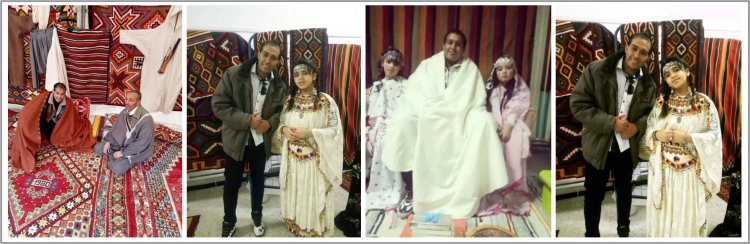
The term "Amazigh" means "free" or "pure," but its interpretation varies among historians and researchers. Other synonyms have been used to describe the Amazigh, according to historical sources, such as "Berbers" and "Libyans."
Accounts of the origins of the Amazigh people have varied throughout history. Ibn Khaldun was among the most prominent historians to address this topic in detail in his book "History of the Berbers," where he dedicated a chapter to discussing the lineages of the Amazigh, as presented by earlier authors. These lineages traced the Amazigh origins to the Levant, suggesting they migrated from Syria and Palestine after being expelled by the Jews following the death of Goliath, and that they settled in Egypt for a very short period.
Ibn Khaldun believed the Amazigh to be "Canaanites who became Berber," stating that they were descendants of Mazigh ibn Canaan. He said, "They are from the descendants of Canaan ibn Ham ibn Noah, as mentioned in the genealogies of the Caliphs. Their father's name was Mazigh, and their brothers were Arkesh and Falastin, the sons of Casluhim ibn Mizraim ibn Ham."
However, contemporary European researchers have differing opinions on the origins of the Amazigh. While the Germans relied on linguistics to trace their roots, the French relied on anthropology.
The Berber Culture: The question of the Berbers' origins is discussed in detail in his book "Berber Civilization: Anthropology of Man, History, Writing, Religions, and Culture," where he divides them into five origins:
The Semitic Origin: Some researchers believe that the Berbers descend from the Arab East and that they migrated from their homelands due to drought and wars, settling in North Africa, specifically in western Egypt, Libya, Tunisia, Algeria, Morocco, northern Sudan, Mali, Niger, Burkina Faso, the Canary Islands, Andalusia, and Sicily in Italy.
The Hamitic Origin: This view suggests that the Berbers are descendants of Ham, son of Noah, who migrated from the Arabian Peninsula and settled in Sudan and North Africa. Some also link their lineage to the Egyptian Copts, considering them also descendants of Ham, son of Noah.
The Indo-European Origin: Some researchers believe that the Berbers originated in India, descended from Japheth, son of Noah (peace be upon him), and migrated from India through Persia and the Caucasus, then across Northern Europe from Finland and Scandinavia, reaching Britain, France, and Spain. However, ancient Greek and Roman historical studies suggest that the Berbers may have European origins.
The African Origin: This view is championed by the Moroccan historian Mohamed Chafik, who asserts that the Berbers are the indigenous inhabitants of North Africa. He argues that a number of Arab historians have almost definitively asserted the Arab origins of the Berbers, a view adopted by proponents of French settler colonialism who justified their actions by claiming the Berbers belonged to the white race, thus legitimizing colonization, according to him. According to this view, the Berbers are of local African origin, specifically from North Africa.
Dual origin: This view says that the Berbers combine two lineages: the Semitic lineage and the Indo-European lineage. This means that a group of Berbers came from India and Europe, while another group came from Yemen and the Levant. This is how the proponents of this view explain the existence of Berbers with blond hair who look very much like Europeans, while there are others who tend towards the Semitic lineage with their dark skin sometimes, or with their white skin at other times.
Prepared for publication by Angela Kosta