

Prof. Dr. Tarana Turan Rahimli
 Moderator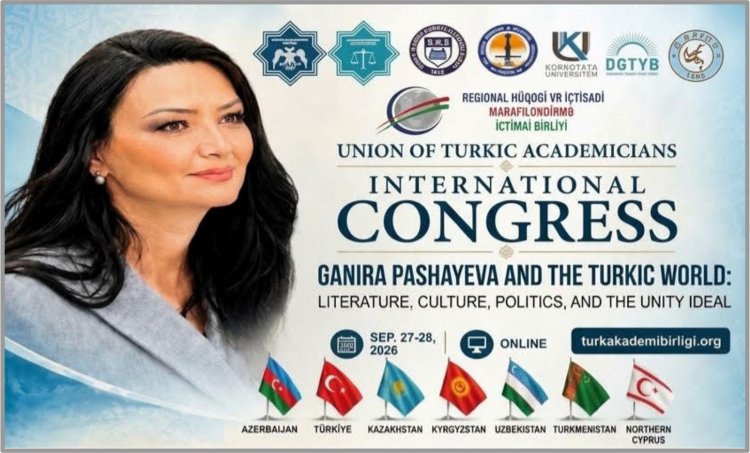
THE INTERNATIONAL CONGRESS ON GANIRA PASHAYEVA BROUGHT TOGETHER SCHOLARS FROM 23 COUNTRIES
Prepared for publication by Angela Kosta
The International Congress titled “Ganira Pashayeva and the Turkic World: Literature, Culture, Politics and the Ideal of Unity” successfully concluded following a rich two-day academic programme. The event, dedicated to the name and intellectual legacy of Ganira Pashayeva and representing the first international academic congress devoted to her, brought together more than 200 scholars, academics, researchers, poets, writers and cultural figures from 23 countries.
Organized online by the Union of Turkish Academicians on 27–28 September 2026, the congress examined, from the perspectives of various academic disciplines, the life, ideas, literary and cultural legacy of Ganira Pashayeva—an eminent Azerbaijani politician, journalist, writer and advocate of the Turkic world—as well as her activities and contributions related to the Turkic world.
As the first international academic congress devoted to Ganira Pashayeva, the event acquired particular academic, cultural and historical significance. The congress created an opportunity to document, through scholarly research, Pashayeva’s multifaceted activities and to examine her ideas concerning the Turkic world from the perspectives of researchers from different countries.
Participants from Azerbaijan, Türkiye, Australia, Germany, Algeria, England, India, Iran, Iraq, Sweden, Italy, Northern Cyprus, the Netherlands, North Macedonia, Kosovo, Kyrgyzstan, Kazakhstan, Malaysia, Russia, Serbia, Turkmenistan, Uzbekistan and Greece took part in the congress. Over the course of two days, a total of 201 papers were presented in seven parallel academic sessions held in five separate virtual halls.
The academic programme brought together numerous fields, including literature, culture, history, politics, international relations, education, sociology, economics, communications, women’s studies, technology and cultural heritage. Thus, Ganira Pashayeva’s legacy was examined in a multidimensional manner not only as that of a political figure, but also through her identities as a poet, writer, journalist, woman leader, cultural figure and advocate of the Turkic world.
The opening and closing programmes of the congress were moderated by Prof. Dr. Vahap Tekin, Head of Department at Dokuz Eylul University. The opening programme featured Assoc. Prof. Dr. Izzettin Ozpolat, President of the Union of Turkish Academicians and President of the Congress; Rashad Majid, Vice President of the Union of Azerbaijani Writers; Assoc. Prof. Dr. Tarana Turan Rahimli, Chair of the Congress Organizing Committee and Vice President of the Union of Turkish Academicians; Zeynel Beksach, Editor-in-Chief of Kosovo’s Turkchem magazine; Vugar Agayev, Editor of AjMedia; and Kamala Pashayeva, sister of Ganira Pashayeva.
One of the most emotional moments of the opening programme was the speech delivered by Kamala Pashayeva, sister of Ganira Pashayeva. Kamala Pashayeva delivered her speech from Ganira Pashayeva’s graveside. Her heartfelt reflections on Ganira Pashayeva’s life, personality and the values she left behind made a particularly deep impression on the participants of the congress.
During the academic sessions held over two days, Ganira Pashayeva’s ideas concerning the Turkic world were examined through the perspectives of literature, culture, politics, diplomacy, women’s studies, history, education and international relations.
Issues related to women, leadership and social identity occupied an important place in the congress. Ganira Pashayeva’s identity as a woman, her political and public activities, the role of women in public life, and women’s leadership in the Turkic world were examined from various academic perspectives.
Political unity in the Turkic world, diplomacy, security and common identity were also among the principal themes of the congress. In addition to parliamentary diplomacy, cultural diplomacy, regional security, collective identity and international cooperation, papers addressed Shusha, Karabakh, the South Caucasus, Turks living in Europe, and relations among Turkic states.
Research on literature and culture constituted another major dimension of the congress. While themes of homeland, mother, woman, history, identity and the idea of the Turkic world in Ganira Pashayeva’s poems and works were examined, the programme also covered a broad range of subjects extending from The Book of Dede Korkut and Aghiska tales to proverbs and expressions, as well as Azerbaijani and Uzbek literature and Kazakh and Turkmen cultural heritage.
One of the notable features of the congress was the bringing together of classical Turkological and cultural studies with contemporary technological and social issues within the same academic programme. Scholars also examined current topics such as artificial intelligence in education, teaching Turkish as a foreign language, the preparation of digital materials, online education, social media, digital diplomacy, information security, cybersecurity and technological sovereignty.
During the sessions held on the second day, topics including Turkic languages and dialects, folklore, history, architecture and museology were discussed alongside contemporary geopolitics in Central Asia, the Middle Corridor, water security, climate change, competition among major powers and academic cooperation. In this way, the congress created a wide-ranging academic platform that examined the Turkic world not only in the context of history and culture, but also within contemporary scientific, technological and international affairs.
The international interest in the congress was also noteworthy. News reports and interviews about the congress were published in the press, television channels, online news outlets and various media platforms in numerous countries. News about the congress appeared in Azerbaijan, Türkiye, North Macedonia, Italy, Pakistan, Albania, Germany, Belgium, England, the Netherlands, Japan, Kenya and many other countries.
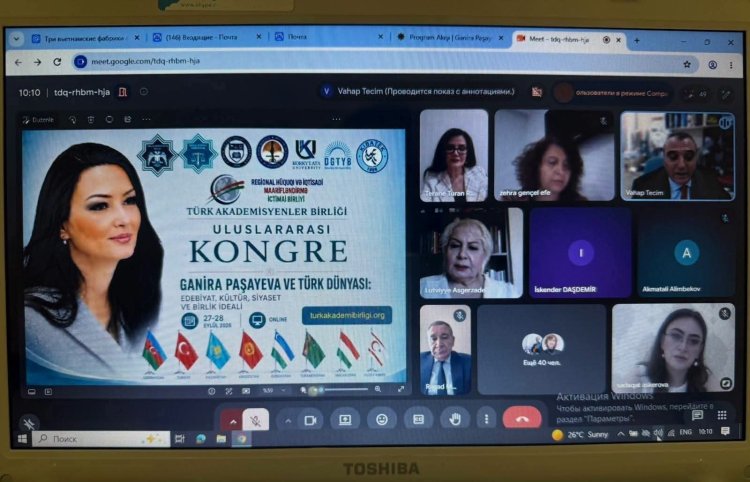
Following the rich two-day academic programme, the closing ceremony featured speeches by Congress President Assoc. Prof. Dr. Izzettin Ozpolat, Prof. Dr. Tarana Turan Rahimli, Chairman of the Kirkuk Cultural Association Shemseddin Kuzechi, as well as members of the Organizing Committee, Prof. Dr. Zehra Gencel Efe, Assoc. Prof. Dr. Minara Aliyeva, Dr. Bedri Shahin and Dr. Alsu Shamsutova.
During the closing programme, the recitation of the poem “This Is How Life Is Lived”, dedicated by Tarana Turan Rahimli to the memory of Ganira Pashayeva, added a particularly emotional dimension to the conclusion of the congress.
The closing speeches emphasized that this first international academic congress devoted to Ganira Pashayeva represented an important beginning in the study, documentation and transmission to future generations of her intellectual, literary and cultural legacy.
Bringing together more than 200 scholars from 23 countries under a common academic umbrella, the congress went down in history as the first international academic congress dedicated to Ganira Pashayeva. It provided an opportunity to examine her multifaceted legacy across a wide range of academic disciplines.
The congress concluded by demonstrating that Ganira Pashayeva’s ideas concerning the Turkic world are not merely a legacy belonging to the past, but rather constitute a multidimensional subject that can continue to be explored in such diverse fields as education, science, culture, literature, technology, academic cooperation and international relations.
From the date the congress was first announced, hundreds of reports about it were published in the international media. Following the congress, Turkish media outlets carried extensive coverage under headlines such as “A Congress That Made Waves Around the World,” “The Congress the World Was Talking About,” and “The Congress That Broke a Record in Türkiye in Terms of Participation and International Impact,” among others.
Ulviya Abulfazgizi